
🌾
Gluten-Free
⚡
Zero Carb
🥛
Dairy-Free
🛡
Allergy-Friendly
🥜
Peanut-Free
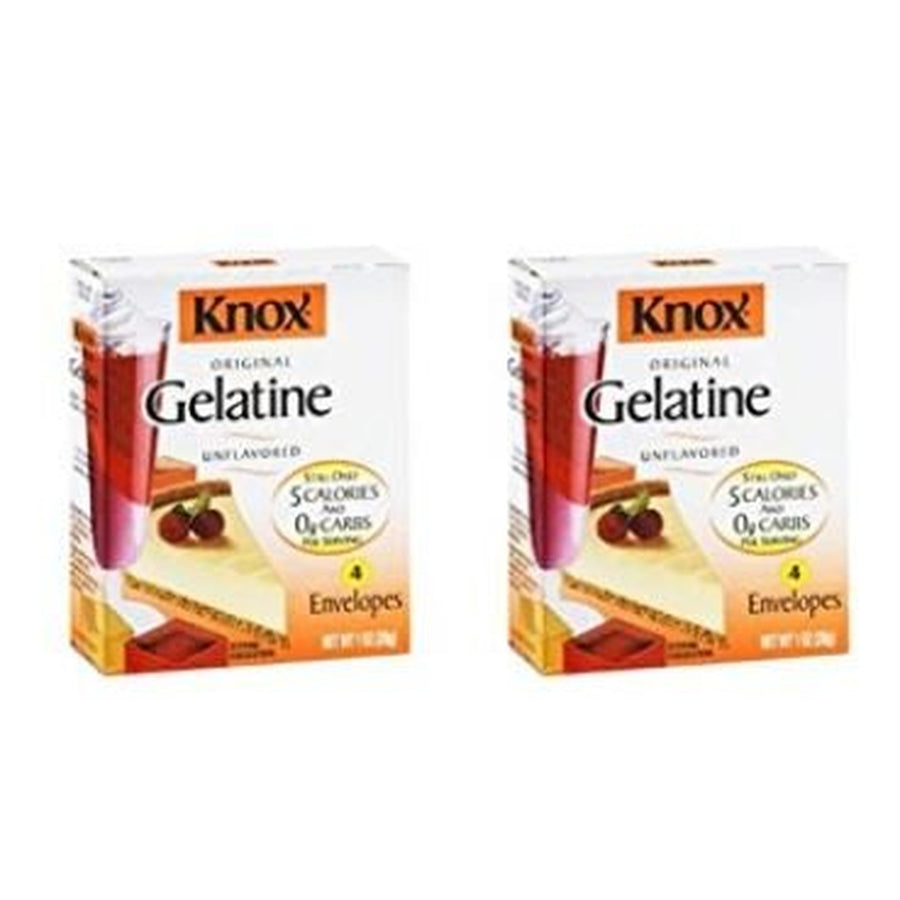
Knox Unflavored Gelatine Packets, 2 Boxes, 8 Packets
$19.76
🚚 Free Shipping on All Orders🕑 Back in Stock Soon🔒 Secure Checkout
Product Details
Knox Original Unflavored Gelatine in single-use envelopes, four to a box. This listing is two boxes, so eight envelopes in all.
Knox is true gelatine, an animal-derived protein, not a plant-based setting agent such as agar or pectin. It carries no flavour, colour or sweetness of its own, so it simply sets whatever it is added to: aspic, pate and terrines on the savoury side, panna cotta, jellies, marshmallows, ice cream and frozen yogurt on the sweet.
Ingredients
Nutrition Information
| Servings per container | 16 (per 4-packet box) |
|---|---|
| Serving size | 1/4 Envelope (1.8g) |
| Calories | 5 |
| Total Fat | 0g (0% DV) |
| Saturated Fat | 0g (0% DV) |
| Trans Fat | 0g |
| Cholesterol | 0mg (0% DV) |
| Sodium | 5mg (0% DV) |
| Total Carbohydrate | 0g (0% DV) |
| Dietary Fiber | 0g (0% DV) |
| Total Sugars | 0g |
| Includes Added Sugars | 0g (0% DV) |
| Protein | 2g (4% DV) |
| Vitamin D | 0mcg (0% DV) |
| Calcium | 0mg (0% DV) |
| Iron | 0mg (0% DV) |
| Potassium | 0mg (0% DV) |
 Knox Unflavored Gelatine Packets, 2 Boxes, ...
$19.76
Knox Unflavored Gelatine Packets, 2 Boxes, ...
$19.76
Questions About This Product
The things people actually want to know before they cook with it.
How much gelatine do I need per cup of liquid?
One envelope holds a quarter of an ounce, about two and a half teaspoons, and sets two cups of liquid to a soft, spoonable set. That is the baseline for a mousse, a panna cotta or a jelly served in a glass. For something firm enough to unmould cleanly, or to cut into squares and pick up with fingers, go to roughly one envelope per cup: the classic Knox Blox uses four envelopes to four cups of liquid. More than that and the texture turns rubbery rather than tender.
How do you bloom gelatine?
Sprinkle one envelope evenly over a quarter cup of cold liquid and leave it about a minute, until the grains swell and go wrinkled and translucent. Then dissolve it gently, either by stirring in hot liquid, warming it over low heat, or microwaving it for 30 to 40 seconds, before folding it into the rest of the recipe. Blooming is what stops lumps: dry granules tipped straight into hot liquid seal on the outside and trap dry powder inside, and no amount of stirring will rescue them.
How many gelatine sheets equal one packet?
Three sheets of leaf gelatine to one envelope is the working rule. Sheets are graded and each grade weighs something different, roughly 3.5 g for bronze at 140 bloom, 2.5 g for silver at 160, 2 g for gold at 200 and 1.75 g for platinum at 230 and up, but they are cut so that one sheet of any grade delivers about the same gelling power. So count sheets rather than weigh them. Powdered supermarket gelatine sits near 225 bloom, which is why the swap works at three to one.
Can you overheat gelatine?
Yes, and boiling is the usual way people ruin a set. Heat the mixture only until the granules have fully dissolved and never bring it to a boil, because sustained high heat breaks the protein chains further and the resulting set is weak or does not happen at all. Low heat, a warm water bath, or a short spell in the microwave are all safe. If a recipe has you add gelatine to a hot mixture, take the pan off the heat first.
Why did my jelly not set?
There are five common causes, and they are all fixable next time. Too little gelatine for the volume of liquid; boiling it, which weakens the protein; undissolved granules, so only part of the gelatine ever went to work; fresh enzyme-carrying fruit in the mix; or too much sugar or alcohol, both of which interfere with the network forming. Time and temperature matter too, since a full set can take several hours in the fridge and will not happen on a counter. A weak set can usually be rescued by warming the mixture gently and stirring in another envelope that has been bloomed separately.
Will gelatine set with fresh pineapple?
No. Fresh pineapple contains bromelain, a protease that cuts the gelatine protein apart faster than it can form a network, so the mixture stays liquid. Kiwi, papaya, fresh figs, fresh ginger, guava and some mango do the same thing through their own enzymes. Heat destroys those enzymes, which is why canned pineapple and cooked or commercially pasteurised juices work perfectly well. Bringing the fruit or its juice to a simmer for a few minutes before it goes near the gelatine solves it.
Is gelatine the same as collagen powder?
They start from the same place and behave completely differently. Gelatine is collagen that has been broken down partway, which is what lets it dissolve in warm liquid and then set as it cools. Collagen peptides are hydrolysed much further, so they dissolve in cold water and never gel at all. If a recipe needs a set, a tub of collagen peptides will not do the job, and gelatine is what to reach for.
Can I use gelatine instead of pectin to make jam?
Not for jam you intend to can. Pectin sets with sugar and acid into a spread that holds at room temperature and can be processed in a boiling water canner using a tested recipe. Gelatine melts near body temperature and its set does not survive canning, so a gelatine-thickened fruit spread is a refrigerator product: keep it cold and use it within about a month. Do not process a gelatine-set spread in a canner and treat it as shelf stable.
Can I use agar instead, and is it a straight swap?
Agar sets the same kinds of dishes but is not a spoon-for-spoon substitute. It comes from seaweed rather than animal collagen, so it suits vegetarian cooking, and it has to be boiled for a few minutes to activate rather than merely dissolved. Its set is firmer and more brittle than gelatine's, it holds together at room temperature instead of softening in the mouth, and it is the wrong choice where you want the melting texture of a panna cotta or a marshmallow. Follow the ratio on the agar packet rather than the gelatine one.
What Shoppers Say
Honest reviews from people who actually bought it.