
🌱
Vegan
🍯
No Added Sugar
🧬
Non-GMO
✡
Kosher
💧
Sodium-Free
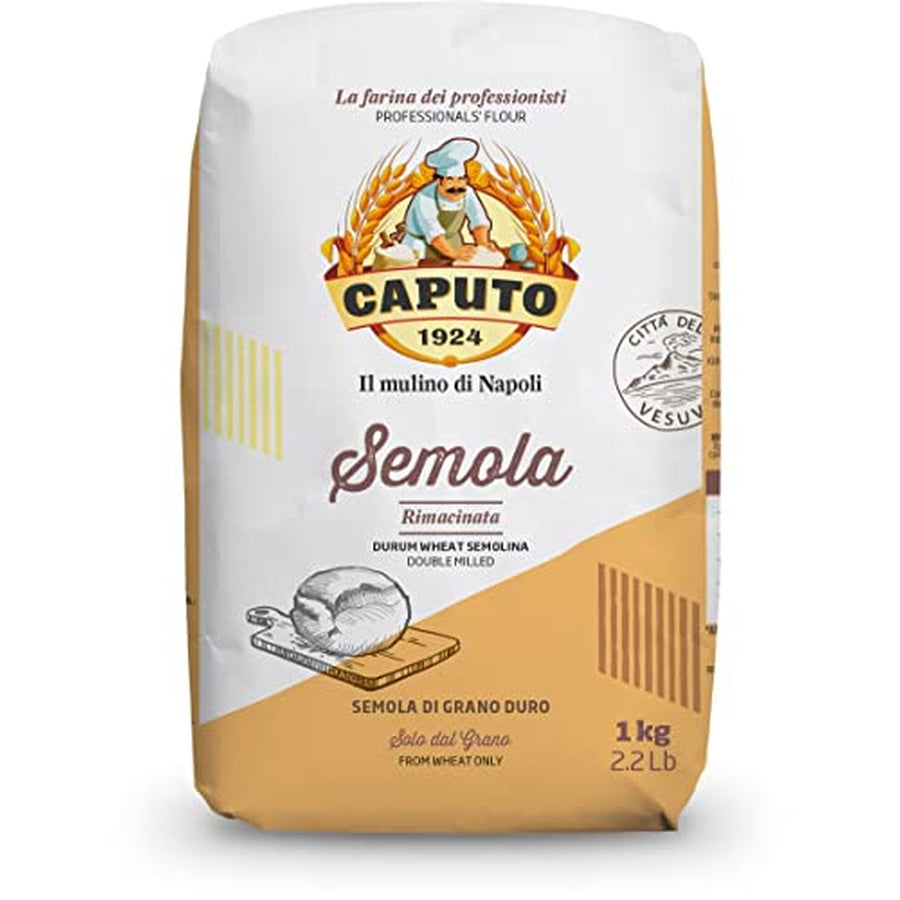
Antimo Caputo Semolina Rimacinata Flour, 2.2 lb
$17.55
🚚 Free Shipping on All Orders🕑 Back in Stock Soon🔒 Secure Checkout
Product Details
Semola di grano duro rimacinata: durum wheat semolina that Caputo mills twice, giving a finer, more even grind than standard coarse semolina, in the pale gold colour typical of the mill's durum flours.
Caputo names fresh and extruded pasta, rustic breads and traditional Italian desserts as its uses; it is also the flour commonly scattered under pizza dough to keep it from sticking. Sold as a 1 kg (2.2 lb) bag, product of Italy.
Ingredients
Nutrition Information
| Servings per container | About 33 |
|---|---|
| Serving size | 1/4 cup (30g) |
| Calories | 100 |
| Total Fat | 0g (0% DV) |
| Saturated Fat | 0g (0% DV) |
| Trans Fat | 0g |
| Cholesterol | 0mg (0% DV) |
| Sodium | 0mg (0% DV) |
| Total Carbohydrate | 22g (8% DV) |
| Dietary Fiber | 1g (4% DV) |
| Total Sugars | <1g |
| Includes Added Sugars | 0g (0% DV) |
| Protein | 4g |
| Vit. D | 0mcg (0% DV) |
| Calcium | 10mg (0% DV) |
| Iron | 0.4mg (2% DV) |
| Potas. | 40mg (0% DV) |
Allergen Information
Contains wheat. May contain soy.
Manufacturers can change formulations at any time, so always read the physical label before consuming.
Manufacturers can change formulations at any time, so always read the physical label before consuming.
Directions & Storage
 Antimo Caputo Semolina Rimacinata Flour, 2....
$17.55
Antimo Caputo Semolina Rimacinata Flour, 2....
$17.55
Questions About This Product
The things people actually want to know before they cook with it.
What does rimacinata mean?
Rimacinata means re-milled, or twice-milled. Durum wheat is first milled into semola, a coarse sandy grind, then sent back through the rollers a second time to produce a fine, powdery flour that hydrates evenly and can be worked into a dough. The full Italian name is semola di grano duro rimacinata. The pale gold colour comes from the durum wheat itself.
What is the difference between semolina rimacinata and regular semolina?
Grind. Ordinary semolina is left coarse and gritty, which suits dusting, couscous and milk puddings but resists forming a smooth dough. Rimacinata is milled a second time to roughly the fineness of flour, so it takes up water evenly and can be kneaded, extruded or shaped. Same wheat, different particle size.
Can I make pasta with it?
Yes, this is the traditional flour for eggless southern Italian pasta such as orecchiette, cavatelli and busiate. Start at about 45 to 50 grams of water per 100 grams of flour, which gives a dough noticeably firmer than an egg dough, and rest it wrapped for at least 45 minutes before shaping. At 13 percent protein it holds an extruded shape and cooks to a firm bite. One kilogram of flour plus roughly 480 grams of water makes about 1.5 kg of fresh pasta dough.
Can I use semolina flour to make bread?
Yes. Re-milled durum semolina is the classic bread flour of Puglia and Sicily, and Pane di Altamura DOP is required to be made from remilled durum semolina, at least 80 percent of it locally grown. The W value of 230 to 250 gives enough strength for a long fermentation. Durum doughs are less elastic than soft wheat doughs and want a slower, gentler handling.
Can I substitute semolina rimacinata for 00 flour?
Not as a straight swap. 00 is soft wheat milled very fine and gives a soft, extensible dough. This is durum, a harder wheat at 13 percent protein, and it makes a firmer, chewier, more golden dough that resists stretching. Replacing all the 00 in a pizza dough changes the texture noticeably; blending a portion in adds bite and colour. For pasta the relationship runs the other way, and semolina is the traditional choice.
Can I use it instead of all-purpose flour?
Not measure for measure in general baking. Durum absorbs more water and its gluten sets up firmer, so cakes and tender cookies come out denser and chewier than intended. Use it where the chew is the point: pasta, rustic loaves, focaccia, flatbreads and some shortbreads. In a mixed dough, swapping a quarter of the all-purpose flour for semolina adds structure without dominating.
Why do people dust the pizza peel with semolina instead of flour?
Coarser granules absorb water more slowly than fine flour, so they stay dry longer and keep a barrier between the dough and the peel, and the larger particles roll like tiny ball bearings so the pizza slides off cleanly. Semolina also clings to the dough less, so less of it ends up on the base. Use a thin scattering either way, since any dusting flour scorches and turns bitter in a hot oven.
Can I use semolina instead of cornmeal?
For dusting peels, pans and proofing boards, yes, and it is the better choice of the two because cornmeal stays gritty on the finished crust while semolina blends in. As an ingredient it is not a substitute. Semolina is wheat, so it will not behave like cornmeal in cornbread, polenta or a gluten-free recipe.
What Shoppers Say
Honest reviews from people who actually bought it.