Questions About This Product
The things people actually want to know before they cook with it.
Why does my Huy Fong Sriracha look darker or browner than the last bottle I bought?
Huy Fong does not add any colorant, so the shade comes entirely from the chilies in that season's harvest. Peppers picked earlier in the season produce a more muted, duller red, while later-harvest batches come out brighter. Bottles also darken naturally over time as the chili pigment reacts with air, which is why an older bottle can look brown rather than red. The company has publicly acknowledged both effects.
Is Huy Fong Sriracha actually spicy, and how does it compare to Tabasco?
It sits in the roughly 1,000 to 2,500 Scoville range, which puts it at the lower end of the mainstream hot sauce shelf. Tabasco Original Red is generally rated at 2,500 to 5,000 Scoville, so it can be about twice as hot. Sriracha reads as milder to most people because the sugar and garlic soften the chili edge, and because it is thick enough that you tend to use less per bite than a thin vinegar sauce.
Why does this taste different from the sriracha I get at Thai restaurants?
Huy Fong's version was created in California and is built on red jalapenos with garlic, sugar and vinegar, giving it a thick, garlicky, moderately sweet profile. Thai-style sriracha, such as Sriraja Panich, is typically thinner, tangier and noticeably sweeter, and is used more as a dipping sauce than a squeeze-on condiment. They share a name and a rough family resemblance but are not interchangeable if you are chasing a specific flavor.
What is the difference between Huy Fong Sriracha, Sambal Oelek and Chili Garlic Sauce?
All three come from the same company but are built differently. Sriracha is smooth, pourable and seasoned with garlic and sugar, so it works as an all-purpose table condiment. Sambal Oelek is essentially chilies, salt and vinegar, thick and spoonable with visible seeds, and it delivers plain chili heat without added sweetness. Chili Garlic Sauce sits between the two, coarse like the sambal but with garlic worked in, and it is usually cooked into a dish rather than squeezed on top.
Why has Huy Fong Sriracha been hard to find in recent years?
The company has had repeated chili supply failures. Production was halted in mid-2022 after drought conditions in Mexico damaged the pepper crop, another shortage was declared in April 2023, and in April 2024 Huy Fong suspended manufacturing until September because the harvest came in too green. Because the sauce depends on a specific red jalapeno at a specific ripeness, a bad growing season translates directly into empty shelves.
Did Huy Fong change the recipe, and is that why people say it tastes different?
Huy Fong has not announced a recipe change, but the company lost its longtime pepper grower, Underwood Ranches, after the two split in 2016, and it now sources chilies from other suppliers. Many longtime buyers report the sauce tastes less bright or less garlicky than it did before that change, while others say they notice no difference. This is a dispute between customers and the manufacturer rather than a documented reformulation, so treat the taste-change claims as opinion, not established fact.
What happened between Huy Fong and Underwood Ranches?
Underwood Ranches grew the jalapenos for Huy Fong for decades before the relationship collapsed and ended up in court. In 2019 a jury sided with the grower, awarding roughly $14.8 million for lost contract revenue plus $10 million in punitive damages, with about $1.46 million deducted for a valid overpayment claim by Huy Fong. Underwood has since launched its own sriracha, which some sriracha drinkers now prefer and others find flatter than the original.
Where can I find the date code on the bottle?
Huy Fong lasers a best-before date onto the bottle near the neck rather than printing it in ink. It is often easier to feel with a fingertip than to read, especially on a bottle that has been handled. If you cannot see it under normal light, tilt the bottle so light rakes across the plastic.
Is Huy Fong Sriracha suitable for a vegan diet?
Huy Fong does not carry a third-party vegan certification on this sauce, so there is no formal claim to point to. What the label declares is chili, sugar, salt, garlic, distilled vinegar, potassium sorbate, sodium bisulfite and xanthan gum, all of which are plant- or mineral-derived, and the sauce is widely used in vegan cooking on that basis. If certification specifically matters to you, this product will not satisfy that standard.
Why is it called rooster sauce, and what does the writing on the bottle mean?
The rooster on the label refers to founder David Tran's Chinese zodiac sign, and the nickname stuck with American fans long before the brand ever leaned into it. The company itself is Huy Fong Foods, named after the freighter that carried Tran out of Vietnam. The text running down the bottle appears in several languages because the sauce was originally aimed at Asian restaurants and grocers in Southern California.
How does the 28 oz bottle compare to the smaller sizes?
Huy Fong sells the sauce in several squeeze-bottle sizes, with 28 oz being the largest of the standard retail bottles, above the common 17 oz and 9 oz options. The sauce inside is identical across all of them; only the volume changes. The 28 oz makes sense for a household that goes through sriracha steadily, since the sauce is stable enough that a large bottle is not a gamble.

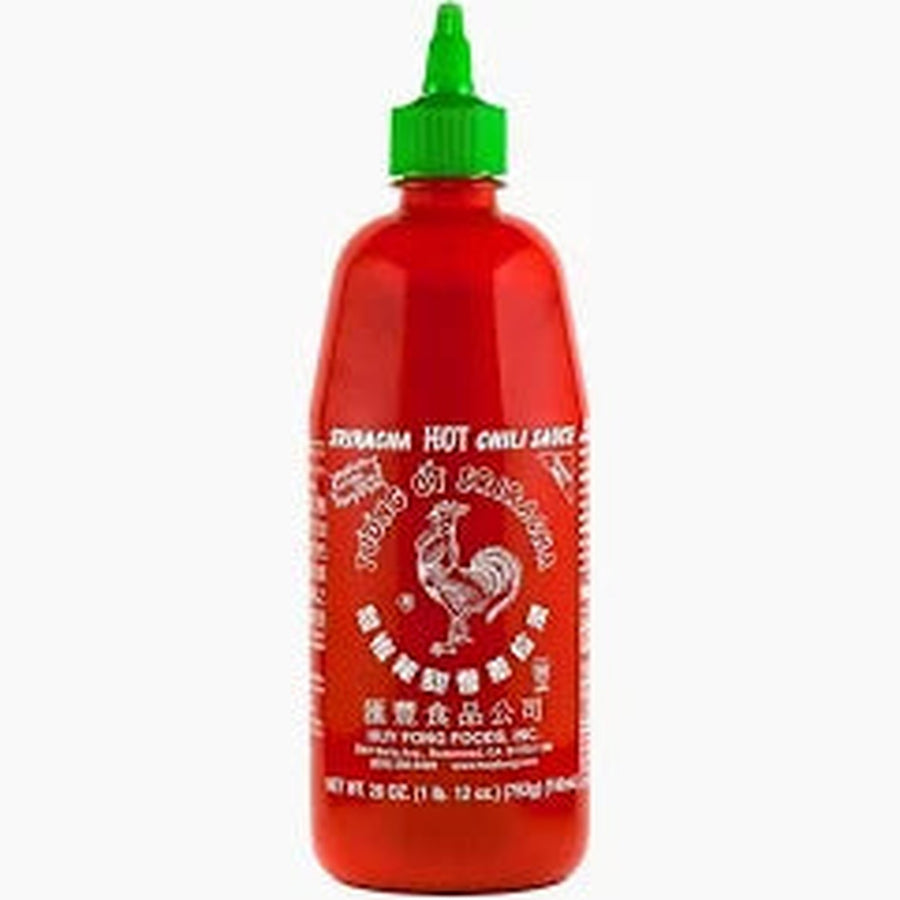
 Huy Fong Sriracha Hot Chili Sauce, 28 oz
$18.47
Huy Fong Sriracha Hot Chili Sauce, 28 oz
$18.47