🌾 Gluten-Free
🔥 Keto
⚡ Zero Carb
🌱 Vegan
🥕 Vegetarian

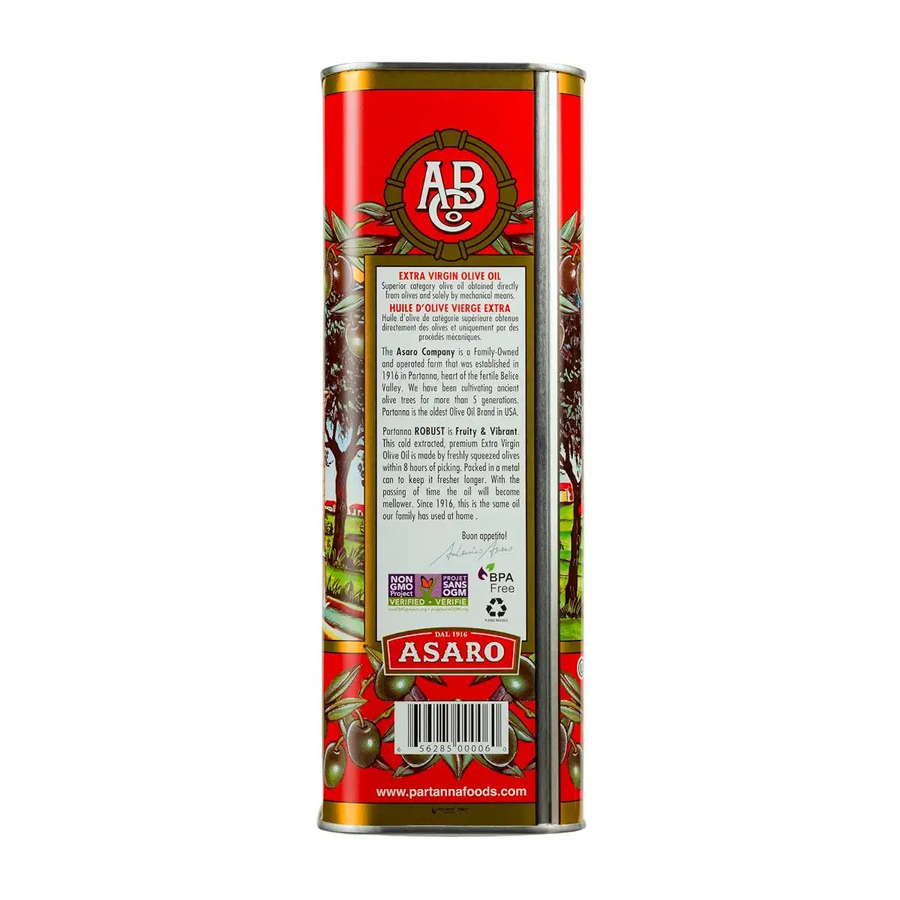
Partanna Robust Extra Virgin Olive Oil, 101 fl oz (3L) Tin

$79.95

🚚 Free Shipping on All Orders✅ In Stock & Ready to Ship🔒 Secure Checkout
Product Details

Product of Italy. Pressed and tinned in Partanna, Sicily by Oleifici Asaro, a family mill that has been working the olive groves of Trapani since 1916. Every drop in this 3-litre tin comes from Sicilian fruit, milled in Sicily and shipped straight to the United States.

Partanna Robust is made from 100 percent Castelvetrano olives, hand-picked each autumn at the point of ripeness the mill considers ideal and cold-pressed within four hours of coming off the tree. That short window between harvest and press is what keeps the polyphenol count high — the producer guarantees 400 to 600 mg per kilogram, the compounds that give a fresh oil its bite. The oil is filtered and packed in a lacquered tin rather than clear glass, because light and oxygen are what turn good olive oil flat.

The flavour is buttery and full through the middle with a clean peppery finish at the back of the throat. It is a cooking oil first: use it for sauteing vegetables, roasting meat and potatoes, building a pan sauce, or in baking where a fruity olive note belongs. It is equally at home finishing a bowl of pasta, a plate of beans, or good bread. The 3-litre size is the one restaurant kitchens and large families reach for — roughly 200 tablespoons per tin.

Partanna oils have taken 3 gold and 4 silver awards at the NYIOOC World Olive Oil Competition, the largest quality contest in the industry. The oil is naturally vegan, vegetarian, gluten-free and dairy-free.

Ingredients

Extra virgin olive oil.

That is the entire ingredient list. Nothing is blended in, refined or added.

Nutrition Information
Serving size1 TBS (15 mL)
Servings per container200
Calories120
Total Fat14 g (18% DV)
Saturated Fat2 g (10% DV)
Trans Fat0 g
Polyunsaturated Fat1 g
Monounsaturated Fat11 g
Cholesterol0 mg (0% DV)
Sodium0 mg (0% DV)
Total Carbohydrate0 g (0% DV)
Dietary Fiber0 g (0% DV)
Total Sugars0 g
Includes Added Sugars0 g (0% DV)
Protein0 g
Vitamin D0 mcg (0% DV)
Calcium0 mg (0% DV)
Iron0 mg (0% DV)
Potassium0 mg (0% DV)
Allergen Information
No allergens are declared on this label.

Manufacturers can change formulations at any time, so always read the physical label before consuming.
Directions & Storage

Store away from heat and light. Keep the tin closed and upright at room temperature, away from the stove and out of direct sun.

Use for sauteing, roasting, pan-frying, baking and finishing. Once opened, use within a few months for best flavour. Refrigeration is not needed and will cloud the oil; it clears again at room temperature.

Partanna Robust Extra Virgin Olive Oil, 101... $79.95

Questions About This Product

The things people actually want to know before they cook with it.

Is Partanna olive oil actually made in Italy?
Yes. It is a product of Italy. The olives are grown in the Trapani province of western Sicily and pressed at the Oleifici Asaro mill in the town of Partanna, which the same family has run since 1916. It is not a blend of oils from several countries bottled in Italy, which is what the vague phrase packed in Italy usually signals on cheaper supermarket oils. Italy is recorded as the country of origin on this listing.
Is this the olive oil from The Bear?
Yes. The red Partanna tin appears in the kitchen scenes of FX's The Bear, and it is the oil Carmy reaches for in season 3. It showed up on screen because it is what a lot of working restaurant kitchens actually buy, not as a paid placement.
What does Partanna Robust taste like?
Buttery and full through the middle with a clean peppery catch at the finish. It is fruity rather than grassy, and the pepper is present without being aggressive. Reviewers consistently describe it as a one-oil kitchen: distinct enough to taste, restrained enough that it does not take over a dish.
Why does it burn or tickle the back of my throat?
That peppery catch is oleocanthal, one of the polyphenols in fresh early-harvest olive oil. It is a sign the oil is fresh and high in antioxidants, not a sign it has gone off. Rancid oil tastes flat, waxy or like old crayons; it does not bite. In Sicily the throat catch is how people judge a good oil.
How many polyphenols does it have?
The producer guarantees 400 to 600 mg per kilogram. That is well above the EU threshold of 250 mg per kilogram used for health claims about olive polyphenols, and it is unusual for a mill to state a guaranteed range at all rather than leave the number off the tin. The level comes from picking early and pressing within four hours.
Can I cook with extra virgin olive oil, or should I only use it raw?
You can cook with it. Extra virgin olive oil smokes at roughly 385 F, which is above normal sauteing, pan-frying and most roasting temperatures. Its high polyphenol and monounsaturated content also make it more resistant to breaking down under heat than many refined seed oils. Use it for sauteing, roasting, shallow frying, baking and finishing. If you are deep frying at 400 F or above, use a cheaper oil for that job.
What are Castelvetrano olives?
Castelvetrano is the name western Sicily uses for the Nocellara del Belice cultivar, best known as the bright green, buttery table olive. Pressed for oil rather than cured, it gives a rounder and less bitter oil than many Italian varieties, which is where the buttery character in this bottle comes from. This oil is monovarietal, meaning it is that one olive rather than a blend.
What is the difference between Partanna Robust and Partanna Smooth?
Robust is the red tin. It is picked earlier, so it carries more polyphenols, more fruit and a stronger peppery finish. Smooth is milder and rounder, aimed at people who want the olive flavour in the background. If you want one oil for everything, Robust is the one most cooks land on.
How do I pour a 3 litre tin without making a mess?
This is the single most common complaint about large tins, and the fix is to stop pouring from it. Decant into a small dark bottle or a cruet you keep by the stove and refill it every week or two. You get a clean pour, the big tin stays sealed and dark most of the time, and the oil at the bottom of the tin keeps far longer. A funnel makes the transfer painless.
How long does a 3 litre tin last once it is opened?
Sealed and stored away from heat and light, plan on using it within about a year of opening, and expect the best flavour in the first four to six months. Oxygen is the enemy, so a tin you dip into daily will age faster than one you decant from. If you cook with olive oil most days, 3 litres is roughly a two to four month supply for a household, which is why the size makes sense.
Does it need to be refrigerated? Mine went cloudy in the cold.
No refrigeration needed, and cloudiness is not a fault. Olive oil naturally thickens and clouds when it gets cold, then clears again at room temperature with no loss of quality. The old trick of putting oil in the fridge to test whether it is real does not work and tells you nothing. Store it in a cupboard away from the stove.
Is it cut with seed oil or other cheaper oils?
No. The ingredient list is one line: extra virgin olive oil. It is a monovarietal single-origin oil pressed at the mill that grew the olives, which is the part of the supply chain where adulteration normally happens. There are no seed oils, no refined olive oil and no added flavouring.
Is the 3 litre tin better value than buying bottles?
Per ounce, considerably. This tin holds 101 fl oz, about six standard 16.9 oz bottles, and works out to roughly a third of the shelf price of the same oil in small tins. The tin also protects the oil better than clear glass. It only makes sense if you actually cook with olive oil regularly, since the savings disappear if the last litre sits open for two years.
What can I use it for?
Everything short of deep frying. Sauteing vegetables and aromatics, roasting chicken and potatoes, searing, building pan sauces and vinaigrettes, baking olive oil cakes and focaccia, finishing pasta, beans, soup and grilled fish, and dipping good bread. The buttery profile means it also works in sweet baking where a grassier Tuscan oil would fight the recipe.

What Shoppers Say

Honest reviews from people who actually bought it.