Questions About This Product
The things people actually want to know before they cook with it.
How much water do I add to the whole bag of Santiago refried beans?
The manufacturer's directions for this size pouch call for a half gallon of boiling water, which is 2 quarts, per full 1.86 lb bag. Pour the boiling water into a deep pan first, add the entire pouch quickly, cover it, and let it stand about 25 minutes before stirring. That resting time is written for a covered pan holding its heat, so on a stovetop you can stir the mix in and hold it over low heat to bring it together faster. Stir well at the end, because the top can look wetter than the bottom until it is mixed.
Can I make just a few servings instead of the whole bag?
Yes, the mix rehydrates in any amount you like. The label figures are about a half cup of dry mix per serving, which comes out to roughly 3/4 cup of boiling water for every 1 cup of dry mix. Add the mix to the hot water rather than the other way around, stir, and let it sit a few minutes before judging the thickness. Keep a little extra hot water on hand to loosen it.
How many servings does a 1.86 lb bag make?
One pouch yields about twenty-three 4 ounce servings, which works out to roughly 5 3/4 pounds of prepared beans, or somewhere around 11 cups. If you portion by the half cup instead, expect about 20 servings. That makes a single bag a practical size for a party, a taco bar, or batch cooking for the week.
How does this compare to buying canned refried beans?
One 1.86 lb pouch rehydrates to roughly the same volume as six standard 16 ounce cans, so it replaces a fair stack of cans in the pantry at a fraction of the weight and shelf space. The dry mix also lets you set the consistency yourself, from a loose spread to a stiff dip, which a can does not. Canned beans win on speed since they are already wet, while the dry mix needs boiling water and a short rest.
Why do my beans keep getting thicker as they sit?
The bean flakes continue absorbing liquid for several minutes after mixing, and they firm up further as they cool. This is normal and easy to correct by stirring in hot water a splash at a time until the texture is back where you want it. If you are holding them for a crowd, keep them covered and expect to loosen them once or twice before serving.
Can I make these with just hot water, without a stove?
Yes, as long as the water is properly boiling when it hits the mix. Stir the dry mix into boiling water in a bowl, insulated container, or pouch, cover it, and let it stand until it has fully softened. This is why the dry mix travels well for camping, tailgating, and dorm cooking where a kettle or a jetboil is all you have.
Do these have whole beans in them or are they smooth?
This is the whole bean version, so the rehydrated beans have visible pieces of pinto bean through a creamy base rather than a uniform puree. Santiago also sells a smooth style for people who want the fully blended texture. If you want the whole bean mix closer to smooth, mash it against the side of the pan or run a stick blender through it briefly.
What should I add to make them taste like restaurant beans?
Because the mix is lightly seasoned on purpose, most people build on it. Common additions are cumin, granulated garlic, chili powder, a chopped chipotle in adobo, a squeeze of lime, or a spoonful of sauteed onion cooked in butter or oil. Stirring in a handful of shredded cheese at the end gives you the glossy texture typical of a Tex-Mex plate.
Can I use these for bean dip or as a burrito filling?
Yes, and the dry mix is well suited to both because you control the water. Use less water than the standard ratio for a thick dip or a filling that will not soak a tortilla, and a little more for a spreadable side. For a layered dip, let the beans cool first so the layers above them hold their line.
Can I freeze the beans after I make them?
Yes, prepared refried beans freeze well, which is how a lot of people handle a full pouch made at once. Freeze them flat in portion sized bags so they thaw quickly and stack neatly. Expect them to come out of the freezer firmer than they went in, so reheat gently and stir in hot water until the texture loosens back up.
Is this a good option for a food storage or emergency pantry?
It is a common choice for that purpose because the dry mix is shelf stable, light, and compact compared with cans, and the manufacturer lists a shelf life of about a year in cool, dry conditions. All the preparation needs is boiling water, so it works with a camp stove or kettle. Buying by the pouch also lets you rotate stock without opening a large bulk container.

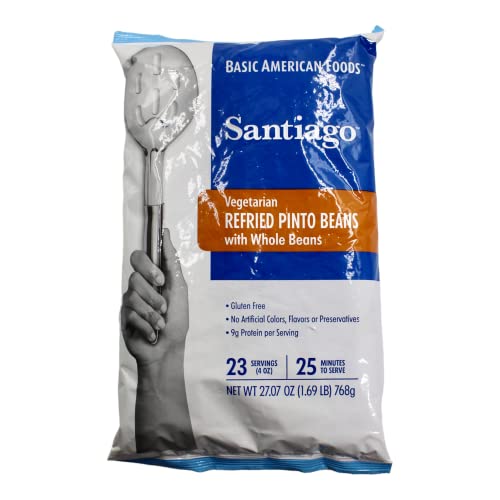
 Santiago Vegetarian Dehydrated Refried Pint...
$21.30
Santiago Vegetarian Dehydrated Refried Pint...
$21.30