🌾 Gluten-Free
Zero Carb
🌱 Vegan
🥕 Vegetarian
🥛 Dairy-Free

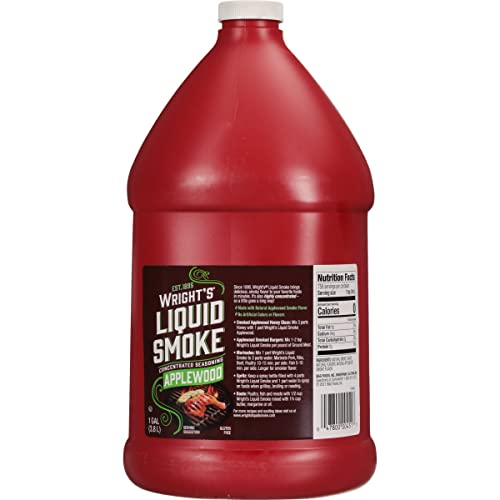
Wright's Applewood Liquid Smoke, 1 Gallon

$41.97

🚚 Free Shipping on All Orders✅ In Stock & Ready to Ship🔒 Secure Checkout
Product Details

A gallon jug of Wright's applewood, the foodservice size, and the format that restaurant kitchens, jerky makers and small sauce producers buy rather than a shelf bottle. It holds 128 fl oz, roughly 768 teaspoons; against the common rule of about a teaspoon per five pounds of meat, that is a great deal of cooking before the jug is empty.

Applewood is what sets it apart from the hickory most cooks start with. Apple is a fruitwood, and its smoke is milder and rounder, with a faint sweetness, where hickory runs assertive and bacon-forward. That makes it the wood for chicken and turkey, pork loin and ham, fish, and for beans, cheese sauces or vegetables where a heavier smoke would take over the dish.

It is concentrated, so it goes in by the teaspoon: stirred through a brine or marinade, whisked into a barbecue or hot sauce base, brushed on before roasting. Work it in at the start of the cook so it has time to settle through.

Ingredients

Natural Smoke Flavor, Natural Flavors, Natural Applewood Smoke Flavor

Nutrition Information
Serving size1 tsp (5 mL)
Calories0
Total Fat0g (0% DV)
Sodium0mg (0% DV)
Total Carbohydrate0g (0% DV)
Protein0g
Not a significant source ofsaturated fat, trans fat, cholesterol, dietary fiber, total sugars, added sugars, vitamin D, calcium, iron and potassium.
Wright's Applewood Liquid Smoke, 1 Gallon $41.97

Questions About This Product

The things people actually want to know before they cook with it.

What does applewood liquid smoke taste like next to hickory?
Milder and faintly sweet. Apple is a fruitwood, so its smoke sits in the light to medium range with a fruity edge, where hickory is bold and bacon like and mesquite is the heaviest and most earthy of the three. The practical consequence is that applewood seasons a dish without taking it over, so it can go into things a heavier smoke would flatten.
What is applewood liquid smoke best used on?
Pork and poultry first: pork loin, ribs, ham, chicken and turkey, where fruitwood is the traditional pairing. It also suits fish and shellfish, and beans, cheese sauces, potatoes and vegetables that a heavy smoke would swamp. It is generally too gentle for large beef cuts such as brisket, which carry hickory or mesquite better.
How much should I use?
Work from the weight of the food, not the volume of the liquid. About a quarter teaspoon per pound is the standard figure, roughly a teaspoon for five pounds, and a brine for five pounds of pork gets that teaspoon whether it is sitting in two quarts of water or four. In a sauce, start with a few drops, taste, then add again rather than dosing the whole batch at once.
Can I swap applewood for hickory one for one?
Yes, the measurement does not change. Expect a lighter and slightly sweeter result, which is usually the reason for the swap in the first place. If you are using it on beef or in a heavily spiced barbecue sauce and want the same weight of smoke that hickory would give, add a little more, tasting as you go rather than doubling.
Why would anyone buy a gallon of liquid smoke?
It is the foodservice pack. A gallon is 128 fl oz, about 768 teaspoons, which at roughly a teaspoon per five pounds of meat is enough for several thousand pounds. That scale makes sense for a restaurant kitchen with no smoker, a jerky operation, a small sauce or marinade producer or a caterer, and no sense at all for a bottle on a home spice shelf.
Will a gallon still be good by the time I get through it?
Wright's gives its liquid smoke a 48 month shelf life, so time is rarely the limiting factor even at this size. The practical problem is handling, since pouring accurately from a gallon jug into a quarter teaspoon is awkward. Most kitchens decant a working amount into a squeeze bottle or a small bottle and leave the jug closed.
Does it give the same result as a smoker?
It gives the smoke flavor in minutes without a fire. What it does not give is bark, which comes from hours of dry low heat working on the surface, or the pink smoke ring, which forms when nitric oxide and carbon monoxide from burning wood react with the myoglobin in the meat. For a roast chicken, a pot of beans or a batch of sauce that difference does not show; for competition brisket it does.
What happens if I overdo it?
The dish turns bitter and ashy instead of smoky and nothing else in it comes through. It cannot be pulled back out, so the recovery is dilution with more of the base recipe. Overshooting is easy with a gallon jug in hand, which is the argument for measuring into a small dish first and pouring from there rather than tipping the jug over the pot.

What Shoppers Say

Honest reviews from people who actually bought it.