Skip to product information
1 of 1

Maldon

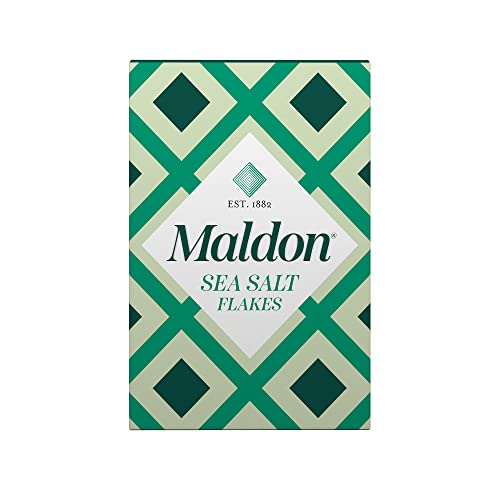
Maldon Sea Salt Flakes, 250 g Box

Maldon Sea Salt Flakes, 250 g Box

Regular price $9.41 USD
Regular price Sale price $9.41 USD
Sale Sold out
Shipping calculated at checkout.
Quantity

Made by the Maldon Crystal Salt Company in the coastal town of Maldon, Essex, in southeast England, where the same business has produced salt since 1882. Seawater drawn from the estuary is filtered and evaporated in shallow pans, and the crystals that form are drawn off by hand, a method the Osborne family has now run across four generations. What comes out of the pans is the shape Maldon is known for: hollow, irregular pyramid flakes rather than the even grains of table salt.

The flakes are soft enough to crush between your fingers, which is why this is usually kept as a finishing salt. Scatter it over roasted vegetables, a steak, sliced tomatoes, chocolate, or focaccia just before serving, while the flake texture is still there to notice. It seasons and bakes perfectly well, but the crystals dissolve and that texture is lost. The 250 g box goes a long way at finishing quantities. Keep it closed and dry.

View full details
🌾 Gluten-Free
🌱 Vegan
🥕 Vegetarian
🥛 Dairy-Free
✡ Kosher

Maldon Sea Salt Flakes, 250 g Box

$9.41

🚚 Free Shipping on All Orders🕑 Back in Stock Soon🔒 Secure Checkout
Product Details

Made by the Maldon Crystal Salt Company in the coastal town of Maldon, Essex, in southeast England, where the same business has produced salt since 1882. Seawater drawn from the estuary is filtered and evaporated in shallow pans, and the crystals that form are drawn off by hand, a method the Osborne family has now run across four generations. What comes out of the pans is the shape Maldon is known for: hollow, irregular pyramid flakes rather than the even grains of table salt.

The flakes are soft enough to crush between your fingers, which is why this is usually kept as a finishing salt. Scatter it over roasted vegetables, a steak, sliced tomatoes, chocolate, or focaccia just before serving, while the flake texture is still there to notice. It seasons and bakes perfectly well, but the crystals dissolve and that texture is lost. The 250 g box goes a long way at finishing quantities. Keep it closed and dry.

Ingredients

Sea salt flakes (100%)

Directions & Storage

Directions: Pinch and sprinkle to finish, or use during cooking for even seasoning.

Storage: Store in a cool, dry place; decant into a salt pig if preferred.

Maldon Sea Salt Flakes, 250 g Box $9.41

Questions About This Product

The things people actually want to know before they cook with it.

A recipe calls for a teaspoon of salt. Can I just use a teaspoon of Maldon?
Not if you want the same seasoning. The flakes are hollow and pack far less densely than fine or granular salt, so a spoonful of Maldon holds much less salt by weight — a quarter cup weighs roughly 33 g against about 76 g for table salt. If the recipe gives grams, weigh it. If it only gives spoons, expect to need roughly two to three times the volume, and taste as you go.
What is the difference between Maldon and kosher salt, and do I need both?
Kosher salt is a coarse granular salt built to dissolve into food as it cooks; Maldon is a flake built to stay intact on the surface of finished food. They are also very different densities — roughly 45 g per quarter cup for Diamond Crystal and about 62 g for Morton, against roughly 33 g for Maldon — so they cannot be swapped spoon for spoon. Most kitchens are better served by a cheap coarse salt for cooking and a box of Maldon for finishing than by trying to make one salt do both jobs.
Does Maldon contain less sodium than table salt?
By weight, no. It is sodium chloride, the same compound as table salt, so a gram of one carries essentially the same sodium as a gram of the other. A teaspoon of Maldon does hold less sodium than a teaspoon of table salt, but only because the flakes are bulkier and a teaspoon of them weighs less. That is a measuring effect, not a property of the salt.
Can I use Maldon for brining, pickling or fermenting?
Chemically it works. It carries no anti-caking agent and no added iodine, which are the two things people avoid in ordinary table salt when fermenting. The catch is measurement: brine and ferment recipes are ratios by weight, such as 2% salt against the weight of the vegetables, so weigh the flakes rather than measuring them by the spoon or you will end up well under-salted. It is also an expensive way to make brine, since the flake texture dissolves and is lost, and a plain non-iodised salt does the same job for less.
Is the smoked Maldon the same salt?
It starts as the same hand-harvested pyramid flakes, which are then smoked over oak. Maldon are specific that this is genuine smoking rather than a smoke flavouring added to the salt, and that the process turns the flakes a light brown or beige and carries a smoky taste. It is a separate product rather than a version of this one, so it is not a substitute where you want a clean salt flavour.

What Shoppers Say

Honest reviews from people who actually bought it.